

Business Interruption Insurance cost guide
How much does Business Interruption Insurance cost for small businesses in 2026? Benchmarks, factors, carrier pricing, and how to save.
Coverage overview
Business interruption insurance covers lost income and ongoing operating expenses (rent, payroll, loan payments) during the period a business is unable to operate due to a covered physical loss.
Any business that depends on a physical location, specific equipment, or supply-chain access to operate — restaurants, retail, manufacturing, hospitality, professional services with office-based operations.
Average cost
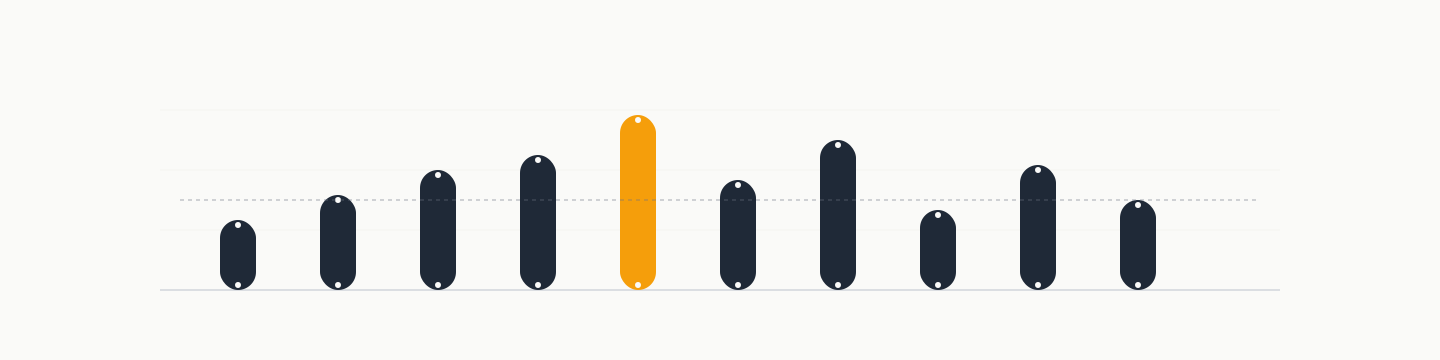
The median small business pays $50/month for business interruption insurance at standard 6–12 months of lost income plus continuing operating expenses limits. Most quotes fall between $33 and $500 per month. The spread reflects the seven factors below, with industry classification and revenue typically driving the largest swings.
Benchmark from BIC carrier-pricing dataset; III/Insureon BI guidance. Quoted figures reflect bound small-business policies, not survey self-reports.
What affects your business interruption insurance cost
Carriers don't price business interruption insurance from a single number. These are the seven inputs they actually weigh, in roughly the order they move premium most.
Net income to be replaced
BI premium is rated on the net income limit you choose to insure. Higher revenue businesses pay more because they have more income to replace. Most carriers compute the limit based on a worst-case 12-month rebuild scenario.
Period of restoration
Standard BI covers 6–12 months of restoration (rebuild) period. Extended periods (18–24 months) for businesses that take longer to fully recover after rebuild add 15–30% to premium. Manufacturing operations and businesses with specialty equipment typically need extended periods.
Industry / business model
Service businesses with low fixed costs typically need less BI than restaurants, retail, or manufacturing with heavy continuing operating expenses. A consultancy might recover 80% of revenue from a temporary office; a restaurant losing its kitchen has near-total revenue loss until rebuild.
Waiting period (deductible)
BI typically has a 24- or 72-hour waiting period before coverage kicks in. Moving from 24-hour to 72-hour cuts premium 5–15% but means absorbing more of the early-recovery costs out-of-pocket.
Underlying property exposure
BI premium tracks the underlying property risk. A building in a wildfire-prone area or hurricane-prone state has both higher property and BI premium than the same-revenue business in a low-catastrophe state.
Coverage extensions
Civil-authority coverage (loss when government closes the area), contingent business interruption (loss from supplier or customer property damage), and extended period of indemnity (post-rebuild revenue ramp) each add 5–15% to premium and matter for specific exposures.
Stop guessing. Get an actual business interruption insurance price.
Tell us your industry, state, and size. We'll match you to the carriers most likely to quote business interruption insurance for your profile, with starting prices side-by-side.
How to lower your business interruption insurance cost
- Quote 3+ carriers at renewal. Premium spreads of 30–50% on the same coverage are routine. The cheapest carrier rotates yearly as each one's loss ratio shifts.
- Bundle into a BOP if you qualify. A business owner's policy combines GL + commercial property at typically 10–25% less than the same coverages bought separately.
- Check your industry classification code. Misclassification (usually a holdover from when the business looked different) is the single most common avoidable cost. A 10-minute conversation with the underwriter can be worth thousands.
- Set a reasonable deductible. Where it's offered, a $500–$2,500 deductible cuts premium 5–15% with negligible exposure for most small businesses.
- Pay annually, not monthly. Most carriers charge a 5–10% installment fee on monthly billing. If cash flow allows, annual saves the spread.
Top business interruption insurance carriers by pricing transparency
Carriers ranked against our 6-dimension methodology, filtered to those we cover that write business interruption insurance.
Sub-threshold = fewer than 20 NAIC complaints in 3 years (data is too sparse to score reliably). N/A (broker) = not a carrier. See full methodology →
| Carrier | Our score | Positioning | Starting price | Coverage | Claims | AM Best | NAIC index | States | Quote channel |
|---|---|---|---|---|---|---|---|---|---|
 | 8.1 | Broad-ladder primary carrier | GL $42/mo | 9.0/10 | 8.0/10 | A++ | Sub-threshold | 50 states | Direct online |
 | 8.1 | Broker comparing 8+ carriers | GL $21/mo | 8.5/10 | 7.5/10 | — | N/A (broker) | 50 states | Broker portal |
 | 7.9 | Single-carrier program for SMBs | GL $68/mo | 9.0/10 | 8.0/10 | A+ | Sub-threshold | 50 states | Direct online |
 | 7.8 | Digital-native micro-business | Cyber $4/mo | 7.0/10 | 7.5/10 | A+ | Sub-threshold | 50 states | Direct online |
 | 7.2 | Berkshire-backed contractual umbrella | GL $28/mo | 8.0/10 | 8.0/10 | A++ | 13.25 | 50 states | Direct online |
 | 7.0 | Professional services E&O focus | GL $30/mo | 7.5/10 | 8.0/10 | A | 8.15 | 50 states | Direct online |
About complaint index data: Values are 3-year averages from NAIC Consumer Information Source for commercial liability. Carriers with fewer than 20 complaints in the 3-year window are labeled "sub-threshold". A reliability call about data volume, not a finding about the carrier. Brokers (Category D) are structurally N/A. See our complete methodology.
- 8.1
- Positioning
- Broad-ladder primary carrier
- Starting price
- GL $42/mo
- Coverage
- 9.0/10
- Claims
- 8.0/10
- AM Best
- A++
- NAIC index
- Sub-threshold
- States
- 50 states
- Quote channel
- Direct online
- 8.1
- Positioning
- Broker comparing 8+ carriers
- Starting price
- GL $21/mo
- Coverage
- 8.5/10
- Claims
- 7.5/10
- AM Best
- —
- NAIC index
- N/A (broker)
- States
- 50 states
- Quote channel
- Broker portal
- 7.9
- Positioning
- Single-carrier program for SMBs
- Starting price
- GL $68/mo
- Coverage
- 9.0/10
- Claims
- 8.0/10
- AM Best
- A+
- NAIC index
- Sub-threshold
- States
- 50 states
- Quote channel
- Direct online
- 7.8
- Positioning
- Digital-native micro-business
- Starting price
- Cyber $4/mo
- Coverage
- 7.0/10
- Claims
- 7.5/10
- AM Best
- A+
- NAIC index
- Sub-threshold
- States
- 50 states
- Quote channel
- Direct online
- 7.2
- Positioning
- Berkshire-backed contractual umbrella
- Starting price
- GL $28/mo
- Coverage
- 8.0/10
- Claims
- 8.0/10
- AM Best
- A++
- NAIC index
- 13.25
- States
- 50 states
- Quote channel
- Direct online
- 7.0
- Positioning
- Professional services E&O focus
- Starting price
- GL $30/mo
- Coverage
- 7.5/10
- Claims
- 8.0/10
- AM Best
- A
- NAIC index
- 8.15
- States
- 50 states
- Quote channel
- Direct online
Business Interruption Insurance cost FAQs
How much does business interruption insurance cost?
Most small businesses pay between $33 and $500/month for business interruption coverage, typically as part of a BOP. Standalone BI endorsements on commercial property run roughly the same range. Premium scales with income to be replaced and the period of restoration chosen.What triggers business interruption coverage?
A covered property loss that forces partial or complete suspension of operations. The triggering loss must be insured under your underlying commercial property or BOP. Fire, theft, certain weather events. Pandemic-related closures, civil unrest, and most utility-failure scenarios are typically excluded unless specifically endorsed.Does business interruption cover COVID-19 closures?
No. The vast majority of standard BI policies require physical damage to insured property as a triggering condition; pandemic-related closures without physical damage do not trigger coverage. Court rulings have largely confirmed this exclusion since 2020. Pandemic insurance is a separate, specialized coverage that grew after COVID-19.How is business interruption different from extra expense coverage?
BI replaces lost net income and continuing operating expenses while you can't operate. Extra expense coverage pays for additional costs to keep operating after a loss. Temporary location rental, expedited equipment replacement, overtime payroll. Most BI policies include some extra-expense coverage; standalone extra-expense is available where needed.What's the difference between BI and contingent business interruption (CBI)?
BI covers loss from damage to your property. CBI covers loss from damage to a key supplier's or customer's property. A supplier whose factory burns down, a major customer whose facility floods. CBI matters for businesses with supply-chain concentration; it's typically a sub-limited add-on to BI ($50K–$500K).Are business interruption premiums tax-deductible?
Yes. BI premium is deductible as part of the underlying commercial property or BOP premium per IRS Publication 535. When BI claims pay out, the recovery is treated as ordinary income (replacing lost revenue) for tax purposes.How long should the period of restoration be?
Standard 12-month period works for most small businesses. Extend to 18–24 months if (a) your operation requires specialty equipment with long replacement lead times, (b) you operate in a regulated industry where re-licensing post-rebuild takes time, or (c) you're a manufacturing operation with custom tooling. The cost of the extension (15–30% of BI premium) is small relative to the gap risk.Does BI cover lost income while a fire damages my building?
Yes. That's the canonical use case. BI pays lost net income for the period the property is unusable due to a covered loss, plus continuing operating expenses (rent, payroll for retained staff, loan payments, utilities). The waiting period (typically 24–72 hours) applies before coverage activates.
Methodology & sources
Median monthly figures and typical-range bounds come from Insureon's published carrier-quote benchmarks. These are real bound-policy quotes, not survey self-reports. It's the most representative public dataset of small-business premium ranges.
Per-policy starting-price floors are sourced from the carriers we cover (10+ small-business insurers) at their published advertised rates. We don't average competitive intel; we report what each carrier publishes.
Industry-wide context (NAIC complaint indices, III definitions, SBA guidance, IRS Publication 535 deductibility) sources every claim that isn't a price benchmark. State-specific WC rates, when shown, originate from each state's rating bureau (NCCI or independent).
Sources cited
Stop guessing. Get an actual business interruption insurance price.
Tell us your industry, state, and size. We'll match you to the carriers most likely to quote business interruption insurance for your profile, with starting prices side-by-side.