

Commercial Umbrella Insurance cost guide
How much does Commercial Umbrella Insurance cost for small businesses in 2026? Benchmarks, factors, carrier pricing, and how to save.
Coverage overview
A commercial umbrella policy extends the limits of specified underlying liability policies, typically general liability, employer's liability (the liability portion of workers' comp), commercial auto liability, and hired and non-owned auto. When a covered claim exhausts the underlying policy's per-occurrence limit, the umbrella pays the remaining amount up to the umbrella limit (commonly $1M to $5M for small businesses). Some umbrella policies are broader than the underlying — "dropping down" to cover claims the underlying would have excluded (subject to a self-insured retention) — while excess liability policies are strictly "follow form" and match the underlying terms exactly. Umbrellas do NOT extend professional liability (E&O), medical malpractice, cyber, D&O, EPLI, commercial property, or commercial crime limits; separate excess policies exist for those. Exclusions mirror the underlying policy plus common umbrella-specific carve-outs like owned aircraft and watercraft above certain sizes.
Small businesses typically buy a commercial umbrella to satisfy contract requirements (landlord, municipality, or enterprise client asking for $2M-$5M total limits), to protect against catastrophic liability events (a serious auto accident or customer injury that blows through a $1M GL limit), and because umbrellas are relatively inexpensive per million of additional coverage. Higher-risk operations — contractors, transportation, businesses with heavy foot traffic, and companies with owned vehicle fleets — benefit most.
Average cost
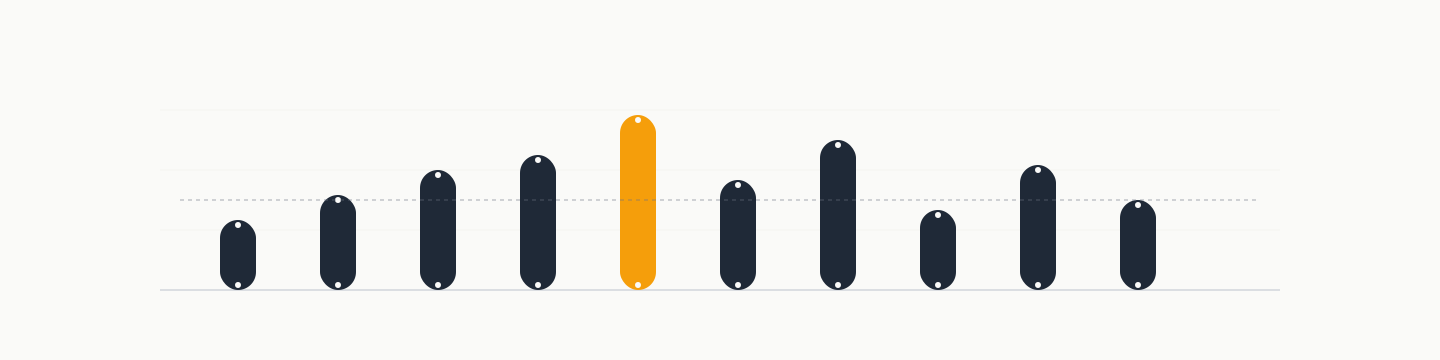
The median small business pays $75/month for commercial umbrella insurance at standard $1M–$5M layered above underlying GL, commercial auto, and employer's liability limits. Most quotes fall between $33 and $583 per month. The spread reflects the seven factors below, with industry classification and revenue typically driving the largest swings.
Benchmark from Insureon Commercial Umbrella cost benchmark. Quoted figures reflect bound small-business policies, not survey self-reports.
What affects your commercial umbrella insurance cost
Carriers don't price commercial umbrella insurance from a single number. These are the seven inputs they actually weigh, in roughly the order they move premium most.
Underlying limits
Umbrella carriers require minimum underlying limits. Typically $1M GL, $1M auto liability, and $500K–$1M employer's liability. Carrying lower underlying limits than required either disqualifies the account or triggers a self-insured retention (SIR) the umbrella sits over.
Industry exposure
Trade contractors with heavy auto exposure, businesses with significant client traffic, and any operation involving heights, heavy equipment, or vulnerable populations face higher umbrella rates than office-based service businesses. The premium ratio across industries can run 4–8x for the same limit and underlying.
Annual revenue and payroll
Umbrella premium scales with the underlying policies it sits over, so revenue and payroll matter indirectly through GL and WC. Carriers typically apply a flat percentage above the underlying premiums (often 20–40% of underlying GL premium for a $1M umbrella).
Vehicle count and use radius
Auto exposure is a larger driver of umbrella pricing than most buyers expect. A business with 5 vehicles in regional service typically pays 30–50% more for umbrella than the same business with 2 local vehicles.
Claims history
Any claim in the past 5 years, even one that didn't pierce the umbrella, typically increases umbrella renewal 10–25%. Umbrella claims that did pierce the underlying often make the account non-standard for at least 2 renewal cycles.
Limit purchased
Premium is roughly linear in limit at the small-business tier. A $2M umbrella usually costs 80–100% more than a $1M umbrella, not 2x. Beyond $5M, premium per million flattens further.
Stop guessing. Get an actual commercial umbrella insurance price.
Tell us your industry, state, and size. We'll match you to the carriers most likely to quote commercial umbrella insurance for your profile, with starting prices side-by-side.
Commercial Umbrella Insurance cost by industry
Industry classification is the single biggest premium driver. Same coverage, same limits, but a different class code can mean a 4×–10× difference in what carriers charge.
| Industry | Range visualization | Annual range |
|---|---|---|
| Landscapers | $1,500–$5,000 | |
| Electricians | $2,500–$8,000 | |
| HVAC Contractors | $3,000–$8,500 | |
| Plumbers | $3,500–$9,000 | |
| Restaurants | $3,500–$9,000 | |
| General Contractors | $3,000–$10,000 | |
| Trucking | $10,000–$25,000 | |
| Physicians | $8,000–$30,000 |
Showing 8 of 12 industries with carrier-validated commercial umbrella insurance cost data. View all industries →
How to lower your commercial umbrella insurance cost
- Quote 3+ carriers at renewal. Premium spreads of 30–50% on the same coverage are routine. The cheapest carrier rotates yearly as each one's loss ratio shifts.
- Bundle into a BOP if you qualify. A business owner's policy combines GL + commercial property at typically 10–25% less than the same coverages bought separately.
- Check your industry classification code. Misclassification (usually a holdover from when the business looked different) is the single most common avoidable cost. A 10-minute conversation with the underwriter can be worth thousands.
- Set a reasonable deductible. Where it's offered, a $500–$2,500 deductible cuts premium 5–15% with negligible exposure for most small businesses.
- Pay annually, not monthly. Most carriers charge a 5–10% installment fee on monthly billing. If cash flow allows, annual saves the spread.
Top commercial umbrella insurance carriers by pricing transparency
Carriers ranked against our 6-dimension methodology, filtered to those we cover that write commercial umbrella insurance.
Sub-threshold = fewer than 20 NAIC complaints in 3 years (data is too sparse to score reliably). N/A (broker) = not a carrier. See full methodology →
| Carrier | Our score | Positioning | Starting price | Coverage | Claims | AM Best | NAIC index | States | Quote channel |
|---|---|---|---|---|---|---|---|---|---|
 | 8.1 | Broad-ladder primary carrier | GL $42/mo | 9.0/10 | 8.0/10 | A++ | Sub-threshold | 50 states | Direct online |
 | 7.9 | Single-carrier program for SMBs | GL $68/mo | 9.0/10 | 8.0/10 | A+ | Sub-threshold | 50 states | Direct online |
 | 7.2 | Berkshire-backed contractual umbrella | GL $28/mo | 8.0/10 | 8.0/10 | A++ | 13.25 | 50 states | Direct online |
 | 7.0 | Venture-backed tech & SaaS | — | 7.0/10 | 7.0/10 | — | N/A (broker) | 50 states | Broker portal |
About complaint index data: Values are 3-year averages from NAIC Consumer Information Source for commercial liability. Carriers with fewer than 20 complaints in the 3-year window are labeled "sub-threshold". A reliability call about data volume, not a finding about the carrier. Brokers (Category D) are structurally N/A. See our complete methodology.
- 8.1
- Positioning
- Broad-ladder primary carrier
- Starting price
- GL $42/mo
- Coverage
- 9.0/10
- Claims
- 8.0/10
- AM Best
- A++
- NAIC index
- Sub-threshold
- States
- 50 states
- Quote channel
- Direct online
- 7.9
- Positioning
- Single-carrier program for SMBs
- Starting price
- GL $68/mo
- Coverage
- 9.0/10
- Claims
- 8.0/10
- AM Best
- A+
- NAIC index
- Sub-threshold
- States
- 50 states
- Quote channel
- Direct online
- 7.2
- Positioning
- Berkshire-backed contractual umbrella
- Starting price
- GL $28/mo
- Coverage
- 8.0/10
- Claims
- 8.0/10
- AM Best
- A++
- NAIC index
- 13.25
- States
- 50 states
- Quote channel
- Direct online
- 7.0
- Positioning
- Venture-backed tech & SaaS
- Starting price
- —
- Coverage
- 7.0/10
- Claims
- 7.0/10
- AM Best
- —
- NAIC index
- N/A (broker)
- States
- 50 states
- Quote channel
- Broker portal
Commercial Umbrella Insurance cost FAQs
How much does commercial umbrella insurance cost?
Most small businesses pay between $33 and $583/month for $1M–$5M of umbrella coverage, with a median near $75/month for $1M per Insureon. Office-based service businesses cluster at the low end; trade contractors and businesses with material auto exposure cluster higher.Do I need commercial umbrella insurance?
Most small businesses with employees, vehicles, or significant client traffic should carry at least $1M umbrella. The cost-to-protection ratio is favorable. $1M of additional liability for $40–$120/month is materially cheaper than the same coverage on the underlying GL or auto. Required by some commercial contracts and large general contractors.What's the difference between umbrella and excess liability?
They are similar but not identical. Excess liability follows the form of the underlying. Same coverage, higher limit. Umbrella can sometimes "drop down" to fill underlying gaps and may include broader coverage than the underlying provides. Most small-business "umbrella" policies are technically excess in form; the names are used interchangeably in the market.Does umbrella cover professional liability or cyber claims?
Standard umbrellas cover only the underlying GL, commercial auto, and employer's liability. They do not extend over professional liability or cyber. Some carriers offer broader umbrella forms that include PL and cyber as scheduled underlyings, but this is the exception, not the default.Can I buy umbrella without buying the underlying GL from the same carrier?
Yes. Many umbrella carriers will write excess over a different carrier's GL or auto, but underwriting becomes more complex and premium typically runs 10–25% higher than monoline placements. The simpler path is bundling all liability with one carrier.Is umbrella tax-deductible?
Yes. Commercial umbrella premium is deductible as an ordinary and necessary business expense per IRS Publication 535. Same treatment as the underlying policies.How much umbrella coverage should a small business carry?
Default: $1M. Move to $2M–$5M if (a) any contract requires it, (b) you have material auto exposure, (c) you have significant client traffic or heavy-equipment operations, or (d) your net business value materially exceeds $1M (the umbrella protects the business assets that exceed underlying limits).Does umbrella cover punitive damages?
It depends on the policy form and the state. Some policies and states allow umbrella to cover punitive damages where insurable; others exclude them or require they be paid out-of-pocket. The exclusion matters most for industries with above-average punitive-damage exposure (trucking, certain professional services, employer-related claims).
Methodology & sources
Median monthly figures and typical-range bounds come from Insureon's published carrier-quote benchmarks. These are real bound-policy quotes, not survey self-reports. It's the most representative public dataset of small-business premium ranges.
Per-policy starting-price floors are sourced from the carriers we cover (10+ small-business insurers) at their published advertised rates. We don't average competitive intel; we report what each carrier publishes.
Industry-wide context (NAIC complaint indices, III definitions, SBA guidance, IRS Publication 535 deductibility) sources every claim that isn't a price benchmark. State-specific WC rates, when shown, originate from each state's rating bureau (NCCI or independent).
Sources cited
Stop guessing. Get an actual commercial umbrella insurance price.
Tell us your industry, state, and size. We'll match you to the carriers most likely to quote commercial umbrella insurance for your profile, with starting prices side-by-side.