

Surety Bond cost guide
How much does Surety Bond cost for small businesses in 2026? Benchmarks, factors, carrier pricing, and how to save.
Coverage overview
A surety bond is a contract among three parties — the principal (the business), the obligee (the party requiring the bond), and the surety (the bonding company) — guaranteeing the principal will fulfill specific contractual or regulatory obligations.
Contractors required to be licensed by state contractor boards, businesses bidding on government or large commercial construction projects, license-and-permit-required businesses (auto dealers, freight brokers, customs brokers, mortgage brokers).
Average cost
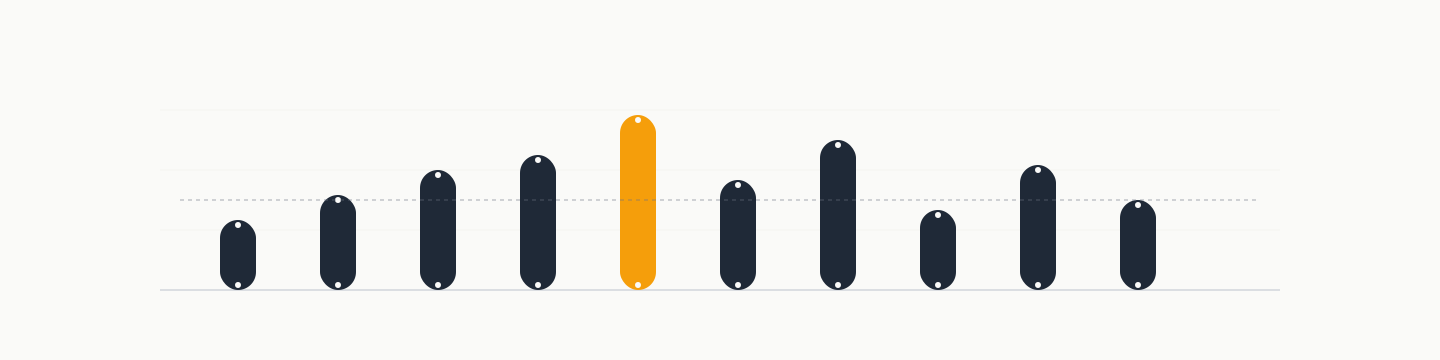
The median small business pays $50/month for surety bond at standard Bond face amount typically $5K–$1M for small business; premium is 1–15% of face amount annually limits. Most quotes fall between $8 and $416 per month. The spread reflects the seven factors below, with industry classification and revenue typically driving the largest swings.
Benchmark from BIC carrier-pricing dataset; III/SBA surety guidance. Quoted figures reflect bound small-business policies, not survey self-reports.
What affects your surety bond cost
Carriers don't price surety bond from a single number. These are the seven inputs they actually weigh, in roughly the order they move premium most.
Bond type
Bond rates vary materially by type. License and permit bonds typically run 1–3% of face amount annually for clean credit; contract performance bonds run 1–3%; court bonds and fidelity bonds run 1–4%; harder-to-place bonds (probate, fiduciary, certain license categories) can run 5–15%.
Personal credit score
Surety underwriting is heavily credit-driven for small business. The principal's personal credit score is the single largest rate factor. A 750+ FICO typically prices at the bottom of the range; a 600 FICO triggers either decline or 5–15% rates. Surety bonds for very poor credit are available but at materially higher rates.
Bond face amount
Small bonds (under $25K) often have flat-fee minimums ($100–$300/year) regardless of percentage rate. Larger bonds (over $250K) typically price at the lower end of the percentage range because surety carriers prefer the larger underwriting fee.
Industry and obligation
Construction performance bonds rate differently than auto-dealer license bonds, which rate differently than freight broker bonds. Industries with high claim frequency (auto dealers, freight brokers) carry higher base rates.
Business financials
For larger bonds (typically $100K+), surety carriers underwrite the business's financial strength. Working capital, net worth, profitability, and prior bonding history. Strong financials unlock better rates; weak financials often require collateral or limit the available bond capacity.
Bonding history
A clean bonding history (no claims paid by the surety) is a positive underwriting factor. Past surety claims, even paid in full by the principal, can affect future bond pricing or limit the surety carriers willing to write the account.
Stop guessing. Get an actual surety bond price.
Tell us your industry, state, and size. We'll match you to the carriers most likely to quote surety bond for your profile, with starting prices side-by-side.
How to lower your surety bond cost
- Quote 3+ carriers at renewal. Premium spreads of 30–50% on the same coverage are routine. The cheapest carrier rotates yearly as each one's loss ratio shifts.
- Bundle into a BOP if you qualify. A business owner's policy combines GL + commercial property at typically 10–25% less than the same coverages bought separately.
- Check your industry classification code. Misclassification (usually a holdover from when the business looked different) is the single most common avoidable cost. A 10-minute conversation with the underwriter can be worth thousands.
- Set a reasonable deductible. Where it's offered, a $500–$2,500 deductible cuts premium 5–15% with negligible exposure for most small businesses.
- Pay annually, not monthly. Most carriers charge a 5–10% installment fee on monthly billing. If cash flow allows, annual saves the spread.
Top surety bond carriers by pricing transparency
Carriers ranked against our 6-dimension methodology, filtered to those we cover that write surety bond.
Sub-threshold = fewer than 20 NAIC complaints in 3 years (data is too sparse to score reliably). N/A (broker) = not a carrier. See full methodology →
| Carrier | Our score | Positioning | Starting price | Coverage | Claims | AM Best | NAIC index | States | Quote channel |
|---|---|---|---|---|---|---|---|---|---|
 | 8.1 | Broad-ladder primary carrier | GL $42/mo | 9.0/10 | 8.0/10 | A++ | Sub-threshold | 50 states | Direct online |
 | 8.1 | Broker comparing 8+ carriers | GL $21/mo | 8.5/10 | 7.5/10 | — | N/A (broker) | 50 states | Broker portal |
 | 7.9 | Single-carrier program for SMBs | GL $68/mo | 9.0/10 | 8.0/10 | A+ | Sub-threshold | 50 states | Direct online |
 | 7.0 | Venture-backed tech & SaaS | — | 7.0/10 | 7.0/10 | — | N/A (broker) | 50 states | Broker portal |
About complaint index data: Values are 3-year averages from NAIC Consumer Information Source for commercial liability. Carriers with fewer than 20 complaints in the 3-year window are labeled "sub-threshold". A reliability call about data volume, not a finding about the carrier. Brokers (Category D) are structurally N/A. See our complete methodology.
- 8.1
- Positioning
- Broad-ladder primary carrier
- Starting price
- GL $42/mo
- Coverage
- 9.0/10
- Claims
- 8.0/10
- AM Best
- A++
- NAIC index
- Sub-threshold
- States
- 50 states
- Quote channel
- Direct online
- 8.1
- Positioning
- Broker comparing 8+ carriers
- Starting price
- GL $21/mo
- Coverage
- 8.5/10
- Claims
- 7.5/10
- AM Best
- —
- NAIC index
- N/A (broker)
- States
- 50 states
- Quote channel
- Broker portal
- 7.9
- Positioning
- Single-carrier program for SMBs
- Starting price
- GL $68/mo
- Coverage
- 9.0/10
- Claims
- 8.0/10
- AM Best
- A+
- NAIC index
- Sub-threshold
- States
- 50 states
- Quote channel
- Direct online
- 7.0
- Positioning
- Venture-backed tech & SaaS
- Starting price
- —
- Coverage
- 7.0/10
- Claims
- 7.0/10
- AM Best
- —
- NAIC index
- N/A (broker)
- States
- 50 states
- Quote channel
- Broker portal
Surety Bond cost FAQs
How much does a surety bond cost?
Premium is typically 1–15% of the bond face amount annually, depending on bond type and credit. A $10K license bond for a clean-credit principal might cost $100/year (1%); the same face amount for poor credit can run $500–$1,500 (5–15%). Most small-business bonds fall between $100 and $5,000 per year.Is a surety bond insurance?
No, despite being sold by insurance carriers and brokers. Surety is a three-party guarantee in which the surety pays the obligee on a valid claim, then seeks reimbursement from the principal (you). Insurance is a two-party risk transfer where the carrier pays a covered loss and bears the cost. The distinction matters at claim time. A surety claim is a debt you owe the surety; an insurance claim is a benefit paid to you.When are surety bonds required?
Common triggers: state contractor licenses, freight broker licenses, auto dealer licenses, mortgage broker licenses, public construction contracts (performance and payment bonds typically required for projects over $100K–$250K), court orders (bonds for executors, fiduciaries, appeals), and certain professional licenses. The obligee, usually a state agency, government body, or contracting party, specifies the required bond.What's the difference between a surety bond and a fidelity bond?
Surety bonds guarantee that the principal will perform an obligation. Fidelity bonds (also called employee dishonesty insurance) protect the business from losses caused by employee theft, fraud, or dishonest acts. Despite the similar name, they're different products with different underwriting. Most small businesses with employees benefit from a fidelity bond; surety bonds are required only when an obligee specifies them.Do I have to repay the surety if a claim is paid?
Yes. Every surety bond has an indemnity agreement. If the surety pays a valid claim to the obligee, the principal (and any personal indemnitors) must reimburse the surety in full. This is the most important difference from insurance. The surety company's primary recovery mechanism is the indemnity agreement.Can I get a surety bond with bad credit?
Yes, but at higher rates. Sub-prime credit (typically below 650 FICO) puts you in the surety industry's "high-risk" tier with rates of 5–15% of face amount versus 1–3% for prime credit. Some bond types (contract bonds for new construction businesses with poor credit) may require collateral or be unwriteable in the open market.Are surety bond premiums tax-deductible?
Yes. Surety bond premium is deductible as an ordinary and necessary business expense per IRS Publication 535 when the bond is required for business purposes. License bonds, contract bonds, and similar required-by-business bonds are deductible; personal-purpose bonds (some court bonds, for example) may not be.How long does it take to get a surety bond?
Small license and permit bonds (under $25K face amount) for clean credit can often be issued same-day. Larger bonds (over $100K) and contract bonds typically take 24–72 hours for underwriting. Bonds with credit issues, large face amounts, or specialty obligees can take 1–2 weeks for full underwriting.
Methodology & sources
Median monthly figures and typical-range bounds come from Insureon's published carrier-quote benchmarks. These are real bound-policy quotes, not survey self-reports. It's the most representative public dataset of small-business premium ranges.
Per-policy starting-price floors are sourced from the carriers we cover (10+ small-business insurers) at their published advertised rates. We don't average competitive intel; we report what each carrier publishes.
Industry-wide context (NAIC complaint indices, III definitions, SBA guidance, IRS Publication 535 deductibility) sources every claim that isn't a price benchmark. State-specific WC rates, when shown, originate from each state's rating bureau (NCCI or independent).
Sources cited
Stop guessing. Get an actual surety bond price.
Tell us your industry, state, and size. We'll match you to the carriers most likely to quote surety bond for your profile, with starting prices side-by-side.