

Directors & Officers Liability Insurance (D&O) cost guide
How much does Directors & Officers Liability Insurance (D&O) cost for small businesses in 2026? Benchmarks, factors, carrier pricing, and how to save.
Coverage overview
D&O policies are structured around three coverage "Sides." Side A pays directly to directors and officers when the company cannot or will not indemnify them (e.g., corporate bankruptcy, derivative suits where indemnification is prohibited, insolvency). Side B reimburses the company when it indemnifies its directors and officers. Side C ("entity coverage") extends coverage to the company itself for claims brought directly against the corporation, typically for securities claims in public companies or for the full range of management claims in private companies. Some programs add a Side A Difference-in-Conditions (DIC) layer with broader terms for pure personal-asset protection. Standard exclusions include intentional fraud or criminal acts (usually subject to "final adjudication" language, so defense is advanced until a final non-appealable ruling), claims between insureds (insured-vs-insured), bodily injury and property damage (GL), professional services (E&O), ERISA/benefits claims (fiduciary liability), and prior known claims. Policies are written on a claims-made basis.
Any company with a board of directors, outside investors, or institutional stakeholders should carry D&O — including private startups, venture-backed companies, nonprofits, and privately held mid-market businesses, not just public companies. Venture capital and private equity term sheets almost always require D&O coverage as a closing condition. Nonprofits need D&O to recruit qualified volunteer board members who would otherwise not serve without personal-asset protection. D&O is typically the first "management liability" line a growing company adds after GL and WC.
Average cost
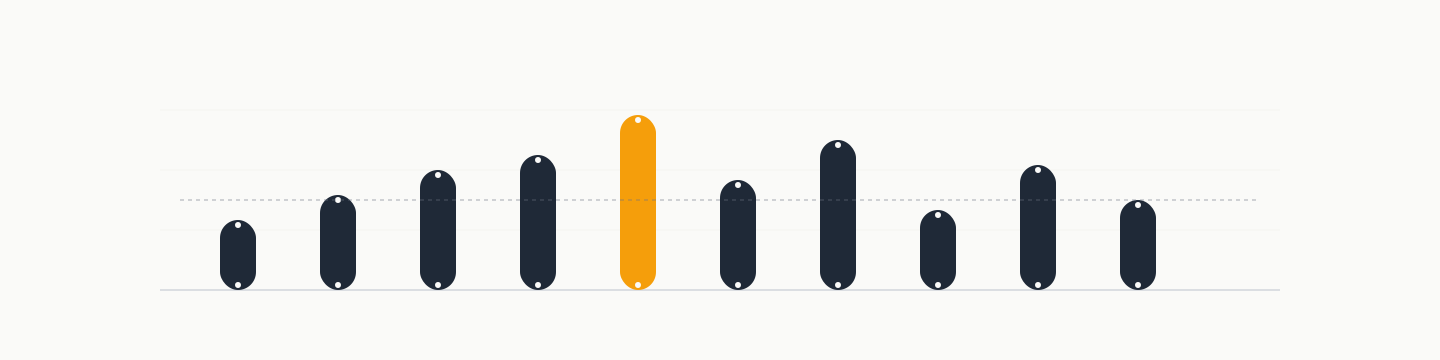
The median small business pays $167/month for directors & officers liability insurance (d&o) at standard $1M per claim / $1M aggregate (smaller private companies); $5M+ for VC-backed and pre-IPO limits. Most quotes fall between $167 and $1250 per month. The spread reflects the seven factors below, with industry classification and revenue typically driving the largest swings.
Benchmark from Insureon D&O cost benchmark. Quoted figures reflect bound small-business policies, not survey self-reports.
What affects your directors & officers liability insurance (d&o) cost
Carriers don't price directors & officers liability insurance (d&o) from a single number. These are the seven inputs they actually weigh, in roughly the order they move premium most.
Company stage and revenue
Pre-revenue startups, growth-stage VC-backed, and mature private companies face very different D&O markets. A pre-Series-A startup might pay $5K–$10K/year for $1M D&O; a $20M-revenue private company pays $8K–$25K; a Series C pre-IPO can pay $50K–$200K+. Stage matters more than absolute revenue at the early end.
Industry
Healthcare, finance, real estate, and crypto-adjacent companies pay materially more than software, services, or manufacturing. Industries with significant regulatory exposure are priced for the regulatory-investigation cost, not just shareholder claims.
Capital structure
VC-backed companies pay more than bootstrapped. Outside investors create derivative-claim exposure that founder-only companies don't have. Each financing round typically increases D&O premium 25–60%, both from increased capital under management and increased shareholder count.
Board composition
Outside directors, especially industry-experienced ones, generally lower D&O premium 10–20% because carriers credit governance discipline. Pure founder-run boards often pay more, particularly at companies with material financing rounds.
Claims and regulatory history
Any prior shareholder claim, regulatory investigation, or even informal SEC inquiry materially affects renewal. Typically 50–200% surcharge or non-renewal. M&A activity, restatements, and material changes in business model also trigger underwriter scrutiny.
Coverage limits and retention
Most private-company D&O is written at $1M/$1M with $25K–$100K retentions. Higher retentions ($250K+) cut premium 25–40% but require comfortable cash reserves. VC-backed companies typically need $5M+ limits per investor requirements.
Geographic footprint
Companies headquartered in or with material operations in plaintiff-friendly jurisdictions (Delaware courts for incorporation; California and New York for operations) face higher rates. International operations add additional underwriting questions and surcharges.
Stop guessing. Get an actual directors & officers liability insurance (d&o) price.
Tell us your industry, state, and size. We'll match you to the carriers most likely to quote directors & officers liability insurance (d&o) for your profile, with starting prices side-by-side.
Directors & Officers Liability Insurance (D&O) cost by industry
Industry classification is the single biggest premium driver. Same coverage, same limits, but a different class code can mean a 4×–10× difference in what carriers charge.
| Industry | Annual range |
|---|---|
| SaaS / Tech Companies | $2,000–$7,000 |
Showing 1 of 2 industries with carrier-validated directors & officers liability insurance (d&o) cost data. View all industries →
How to lower your directors & officers liability insurance (d&o) cost
- Quote 3+ carriers at renewal. Premium spreads of 30–50% on the same coverage are routine. The cheapest carrier rotates yearly as each one's loss ratio shifts.
- Bundle into a BOP if you qualify. A business owner's policy combines GL + commercial property at typically 10–25% less than the same coverages bought separately.
- Check your industry classification code. Misclassification (usually a holdover from when the business looked different) is the single most common avoidable cost. A 10-minute conversation with the underwriter can be worth thousands.
- Set a reasonable deductible. Where it's offered, a $500–$2,500 deductible cuts premium 5–15% with negligible exposure for most small businesses.
- Pay annually, not monthly. Most carriers charge a 5–10% installment fee on monthly billing. If cash flow allows, annual saves the spread.
Top directors & officers liability insurance (d&o) carriers by pricing transparency
Carriers ranked against our 6-dimension methodology, filtered to those we cover that write directors & officers liability insurance (d&o).
Sub-threshold = fewer than 20 NAIC complaints in 3 years (data is too sparse to score reliably). N/A (broker) = not a carrier. See full methodology →
| Carrier | Our score | Positioning | Starting price | Coverage | Claims | AM Best | NAIC index | States | Quote channel |
|---|---|---|---|---|---|---|---|---|---|
 | 8.1 | Broad-ladder primary carrier | GL $42/mo | 9.0/10 | 8.0/10 | A++ | Sub-threshold | 50 states | Direct online |
 | 7.9 | Single-carrier program for SMBs | GL $68/mo | 9.0/10 | 8.0/10 | A+ | Sub-threshold | 50 states | Direct online |
 | 7.0 | Venture-backed tech & SaaS | — | 7.0/10 | 7.0/10 | — | N/A (broker) | 50 states | Broker portal |
 | 7.0 | Professional services E&O focus | GL $30/mo | 7.5/10 | 8.0/10 | A | 8.15 | 50 states | Direct online |
About complaint index data: Values are 3-year averages from NAIC Consumer Information Source for commercial liability. Carriers with fewer than 20 complaints in the 3-year window are labeled "sub-threshold". A reliability call about data volume, not a finding about the carrier. Brokers (Category D) are structurally N/A. See our complete methodology.
- 8.1
- Positioning
- Broad-ladder primary carrier
- Starting price
- GL $42/mo
- Coverage
- 9.0/10
- Claims
- 8.0/10
- AM Best
- A++
- NAIC index
- Sub-threshold
- States
- 50 states
- Quote channel
- Direct online
- 7.9
- Positioning
- Single-carrier program for SMBs
- Starting price
- GL $68/mo
- Coverage
- 9.0/10
- Claims
- 8.0/10
- AM Best
- A+
- NAIC index
- Sub-threshold
- States
- 50 states
- Quote channel
- Direct online
- 7.0
- Positioning
- Venture-backed tech & SaaS
- Starting price
- —
- Coverage
- 7.0/10
- Claims
- 7.0/10
- AM Best
- —
- NAIC index
- N/A (broker)
- States
- 50 states
- Quote channel
- Broker portal
- 7.0
- Positioning
- Professional services E&O focus
- Starting price
- GL $30/mo
- Coverage
- 7.5/10
- Claims
- 8.0/10
- AM Best
- A
- NAIC index
- 8.15
- States
- 50 states
- Quote channel
- Direct online
Directors & Officers Liability Insurance (D&O) cost FAQs
How much does D&O insurance cost?
Most private companies pay between $167 and $1,250/month for $1M D&O, with a median near $167/month per Insureon. Pre-revenue startups cluster at the low end; VC-backed growth-stage companies and businesses with regulatory exposure cluster higher. Public-company D&O is materially more expensive and outside the small-business range.Does my business need D&O insurance?
Yes if you have any of: outside investors, a formal board of directors, regulatory exposure (healthcare, finance, public sector contracting), or contractually required by an investor or contract. Sole-proprietor, founder-only LLCs without outside investors generally don't need D&O. There are no directors or officers in the legal sense to protect.What does D&O actually cover?
Standard private-company D&O covers wrongful acts (errors, omissions, breach of duty) by directors and officers, defense costs for regulatory investigations, derivative claims by shareholders, and "entity coverage" (claims against the company itself for management actions). Most policies also include employment-related coverage that overlaps with EPLI.What's the difference between Side A, Side B, and Side C coverage?
Side A covers individual directors and officers when the company can't indemnify them (typically because of insolvency or legal restriction). Side B covers the company's reimbursement of indemnification payments to directors and officers. Side C covers claims against the entity itself. Most private-company D&O bundles all three; public-company D&O sometimes separates Side A as a dedicated policy for board protection.Does D&O cover employment-related claims?
Many private-company D&O policies include employment-related claims (wrongful termination, discrimination, harassment) within the same form, but coverage scope varies. A dedicated EPLI policy typically provides broader employment coverage with higher sub-limits and more specific defense provisions. Quote both as a combined program when possible.Is D&O tax-deductible?
Yes. D&O premium is deductible as an ordinary and necessary business expense per IRS Publication 535. The deduction applies to the corporate entity; payments by individual directors for personal D&O coverage outside the company policy are typically not deductible by the individual.When should a startup buy D&O?
Two triggering events: first outside investment (a single angel investor often suffices), or formation of a formal board with outside directors. Pre-investment, founder-only startups generally don't need D&O. Post-investment, the lead investor typically requires it. Often before close. Embroker's ability to bind D&O within 24–48 hours makes it the default for fast-closing rounds.Does D&O cover claims by employees?
Some employment-related claims are covered under the D&O's "entity coverage" or as part of bundled D&O+EPLI, but pure wage-and-hour claims, harassment, and discrimination are usually better covered by EPLI. Combined D&O+EPLI policies are common for private companies and often the most cost-effective structure.
Methodology & sources
Median monthly figures and typical-range bounds come from Insureon's published carrier-quote benchmarks. These are real bound-policy quotes, not survey self-reports. It's the most representative public dataset of small-business premium ranges.
Per-policy starting-price floors are sourced from the carriers we cover (10+ small-business insurers) at their published advertised rates. We don't average competitive intel; we report what each carrier publishes.
Industry-wide context (NAIC complaint indices, III definitions, SBA guidance, IRS Publication 535 deductibility) sources every claim that isn't a price benchmark. State-specific WC rates, when shown, originate from each state's rating bureau (NCCI or independent).
Sources cited
Stop guessing. Get an actual directors & officers liability insurance (d&o) price.
Tell us your industry, state, and size. We'll match you to the carriers most likely to quote directors & officers liability insurance (d&o) for your profile, with starting prices side-by-side.