

Inland Marine Insurance cost guide
How much does Inland Marine Insurance cost for small businesses in 2026? Benchmarks, factors, carrier pricing, and how to save.
Coverage overview
Inland marine insurance covers business property that moves — tools, equipment, inventory, goods in transit, exhibits, and items temporarily at locations away from the primary business premises.
Contractors, mobile service businesses, transporters, jewelers, photographers, equipment-heavy businesses, and any business that regularly moves valuable property between locations.
Average cost
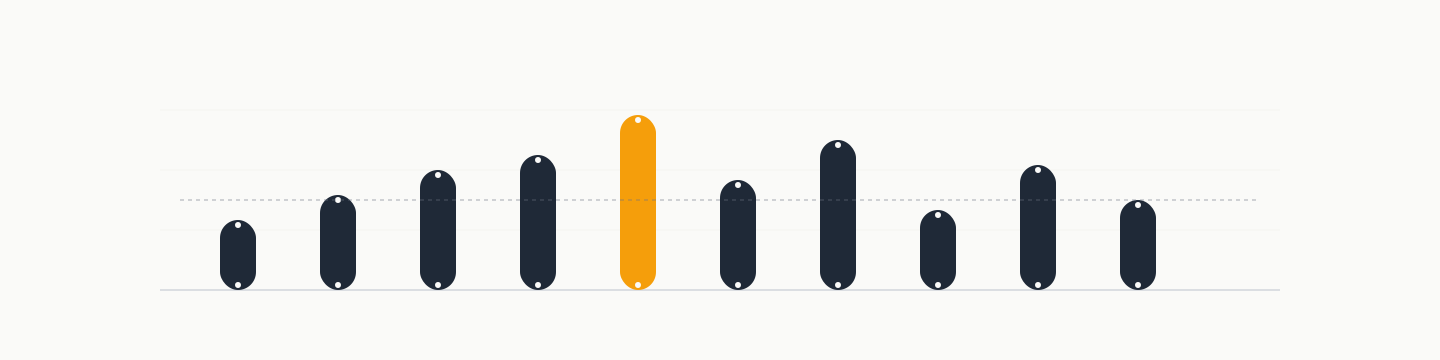
The median small business pays $25/month for inland marine insurance at standard Scheduled equipment value or floater limit (typically $5K–$250K for small business) limits. Most quotes fall between $17 and $250 per month. The spread reflects the seven factors below, with industry classification and revenue typically driving the largest swings.
Benchmark from BIC carrier-pricing dataset (typical small-business inland-marine entry point). Quoted figures reflect bound small-business policies, not survey self-reports.
What affects your inland marine insurance cost
Carriers don't price inland marine insurance from a single number. These are the seven inputs they actually weigh, in roughly the order they move premium most.
Insured value
Inland marine is value-rated. Total scheduled equipment value drives premium directly. A $20K toolset costs materially less to insure than a $200K equipment package, even when the type of equipment is similar.
Equipment type
Hand tools, power tools, and small equipment rate differently than heavy mobile equipment (excavators, lifts, generators). Specialty equipment (medical, audio-visual, professional photography) typically has dedicated rating classifications.
Where used and stored
Equipment that travels regional or interstate rates higher than equipment used near the home base. Overnight storage location matters. Secured commercial yard, locked job-trailer, or owner's residence each price differently.
Theft loss history
Tool theft is the most common inland-marine claim. A single theft loss in the past 3 years can add 25–50% to renewal; multiple losses often push the account to surplus lines.
Coverage form
Named-perils forms cover only listed causes of loss; all-risk forms cover any cause not specifically excluded. All-risk costs 15–30% more but is the right form for most equipment exposures because exclusions are clearer than inclusions.
Deductible
Standard inland marine deductibles range $250–$2,500. Moving from $250 to $1,000 typically cuts premium 10–20%. Higher deductibles work for mature businesses with comfortable cash reserves.
Specialty exposures
Equipment in transit (especially via owner-driven vehicle), exhibition equipment, leased/rented equipment, and equipment used in specialty applications (heights, water, mining) each carry specific underwriting considerations and may need scheduled coverage rather than blanket.
Stop guessing. Get an actual inland marine insurance price.
Tell us your industry, state, and size. We'll match you to the carriers most likely to quote inland marine insurance for your profile, with starting prices side-by-side.
How to lower your inland marine insurance cost
- Quote 3+ carriers at renewal. Premium spreads of 30–50% on the same coverage are routine. The cheapest carrier rotates yearly as each one's loss ratio shifts.
- Bundle into a BOP if you qualify. A business owner's policy combines GL + commercial property at typically 10–25% less than the same coverages bought separately.
- Check your industry classification code. Misclassification (usually a holdover from when the business looked different) is the single most common avoidable cost. A 10-minute conversation with the underwriter can be worth thousands.
- Set a reasonable deductible. Where it's offered, a $500–$2,500 deductible cuts premium 5–15% with negligible exposure for most small businesses.
- Pay annually, not monthly. Most carriers charge a 5–10% installment fee on monthly billing. If cash flow allows, annual saves the spread.
Top inland marine insurance carriers by pricing transparency
Carriers ranked against our 6-dimension methodology, filtered to those we cover that write inland marine insurance.
Sub-threshold = fewer than 20 NAIC complaints in 3 years (data is too sparse to score reliably). N/A (broker) = not a carrier. See full methodology →
| Carrier | Our score | Positioning | Starting price | Coverage | Claims | AM Best | NAIC index | States | Quote channel |
|---|---|---|---|---|---|---|---|---|---|
 | 8.1 | Broad-ladder primary carrier | GL $42/mo | 9.0/10 | 8.0/10 | A++ | Sub-threshold | 50 states | Direct online |
 | 8.1 | Broker comparing 8+ carriers | GL $21/mo | 8.5/10 | 7.5/10 | — | N/A (broker) | 50 states | Broker portal |
 | 7.9 | Single-carrier program for SMBs | GL $68/mo | 9.0/10 | 8.0/10 | A+ | Sub-threshold | 50 states | Direct online |
 | 7.2 | Berkshire-backed contractual umbrella | GL $28/mo | 8.0/10 | 8.0/10 | A++ | 13.25 | 50 states | Direct online |
 | 7.0 | Venture-backed tech & SaaS | — | 7.0/10 | 7.0/10 | — | N/A (broker) | 50 states | Broker portal |
 | 7.0 | Professional services E&O focus | GL $30/mo | 7.5/10 | 8.0/10 | A | 8.15 | 50 states | Direct online |
About complaint index data: Values are 3-year averages from NAIC Consumer Information Source for commercial liability. Carriers with fewer than 20 complaints in the 3-year window are labeled "sub-threshold". A reliability call about data volume, not a finding about the carrier. Brokers (Category D) are structurally N/A. See our complete methodology.
- 8.1
- Positioning
- Broad-ladder primary carrier
- Starting price
- GL $42/mo
- Coverage
- 9.0/10
- Claims
- 8.0/10
- AM Best
- A++
- NAIC index
- Sub-threshold
- States
- 50 states
- Quote channel
- Direct online
- 8.1
- Positioning
- Broker comparing 8+ carriers
- Starting price
- GL $21/mo
- Coverage
- 8.5/10
- Claims
- 7.5/10
- AM Best
- —
- NAIC index
- N/A (broker)
- States
- 50 states
- Quote channel
- Broker portal
- 7.9
- Positioning
- Single-carrier program for SMBs
- Starting price
- GL $68/mo
- Coverage
- 9.0/10
- Claims
- 8.0/10
- AM Best
- A+
- NAIC index
- Sub-threshold
- States
- 50 states
- Quote channel
- Direct online
- 7.2
- Positioning
- Berkshire-backed contractual umbrella
- Starting price
- GL $28/mo
- Coverage
- 8.0/10
- Claims
- 8.0/10
- AM Best
- A++
- NAIC index
- 13.25
- States
- 50 states
- Quote channel
- Direct online
- 7.0
- Positioning
- Venture-backed tech & SaaS
- Starting price
- —
- Coverage
- 7.0/10
- Claims
- 7.0/10
- AM Best
- —
- NAIC index
- N/A (broker)
- States
- 50 states
- Quote channel
- Broker portal
- 7.0
- Positioning
- Professional services E&O focus
- Starting price
- GL $30/mo
- Coverage
- 7.5/10
- Claims
- 8.0/10
- AM Best
- A
- NAIC index
- 8.15
- States
- 50 states
- Quote channel
- Direct online
Inland Marine Insurance cost FAQs
How much does inland marine insurance cost?
Most small businesses pay between $17 and $250/month for inland marine, with the entry tier at roughly $20–$30/month for $25K–$50K of scheduled equipment. Premium scales linearly with insured value at the small-business tier and is typically 1–3% of insured value annually.Why is it called "inland marine"?
Historical artifact. The coverage grew out of ocean marine cargo insurance that needed to extend protection to property after it left the water. Today's inland marine has nothing to do with boats or water; it covers any business property that moves between locations, including tools, equipment, exhibition property, and goods in transit.Do I need inland marine if I have a BOP?
BOPs cover business personal property at the insured location. Property that moves between job sites, contractor tools, mobile equipment, equipment loaned to clients, property in transit, is covered only if you add an inland-marine endorsement to the BOP or buy standalone inland-marine. For most contractors and field-service businesses, the answer is yes. BOP alone leaves a coverage gap.Does inland marine cover tools stolen from my truck overnight?
Most inland-marine forms cover overnight theft from a vehicle, but coverage is often sub-limited (typically $1K–$10K per occurrence) unless the equipment is specifically scheduled. For high-value tool sets, schedule individual items or buy a higher overnight-from-vehicle sub-limit. Read the policy form. This is the most common claim and the most common coverage gap.What's the difference between blanket and scheduled inland marine?
Blanket coverage applies a single limit to all covered equipment (e.g., $50K total). Scheduled coverage lists specific items with individual values and limits ($30K excavator, $10K generator, $5K specialty tool). Scheduled is more accurate but requires updating the schedule as equipment changes; blanket is simpler but caps payout at the blanket limit regardless of total value lost.Are inland marine premiums tax-deductible?
Yes. Inland marine premium is deductible as an ordinary and necessary business expense per IRS Publication 535. Same treatment as commercial property and other business policies.Does inland marine cover rented or leased equipment?
Yes, but coverage often requires the equipment to be specifically endorsed onto the policy. Many rental contracts require renters to carry inland-marine coverage with the rental company as a loss payee. If you rent equipment regularly, an open-rental endorsement avoids individual scheduling.How is inland marine different from commercial auto?
Commercial auto covers liability and physical damage to vehicles. Inland marine covers the equipment, tools, and property carried inside or on the vehicles. And elsewhere on job sites. A pickup truck has commercial auto on the vehicle and inland marine on the tools in its bed. Both policies overlap minimally and most operations need both.
Methodology & sources
Median monthly figures and typical-range bounds come from Insureon's published carrier-quote benchmarks. These are real bound-policy quotes, not survey self-reports. It's the most representative public dataset of small-business premium ranges.
Per-policy starting-price floors are sourced from the carriers we cover (10+ small-business insurers) at their published advertised rates. We don't average competitive intel; we report what each carrier publishes.
Industry-wide context (NAIC complaint indices, III definitions, SBA guidance, IRS Publication 535 deductibility) sources every claim that isn't a price benchmark. State-specific WC rates, when shown, originate from each state's rating bureau (NCCI or independent).
Sources cited
Stop guessing. Get an actual inland marine insurance price.
Tell us your industry, state, and size. We'll match you to the carriers most likely to quote inland marine insurance for your profile, with starting prices side-by-side.