

Commercial Auto Insurance cost guide
How much does Commercial Auto Insurance cost for small businesses in 2026? Benchmarks, factors, carrier pricing, and how to save.
Coverage overview
A commercial auto policy typically includes: liability coverage for bodily injury and property damage caused to others in an at-fault accident; collision and comprehensive coverage (optional) to repair or replace the business's own vehicle from accidents, theft, vandalism, fire, flood, hail, or falling objects; uninsured/underinsured motorist coverage; medical payments or personal injury protection (PIP) for occupants; and hired and non-owned auto (HNOA) coverage for rented vehicles and employee-owned vehicles used for business. Exclusions include intentional damage, racing, using a vehicle for commercial purposes not disclosed on the application (e.g., livery without a livery endorsement), wear and tear, mechanical breakdown, and damage from war or nuclear incidents. Personal auto policies typically exclude business use of a vehicle, which is why a commercial policy is required for owned business vehicles.
Any business that owns vehicles titled in the business name, uses vehicles to transport goods or clients, or has employees driving company-provided vehicles needs commercial auto. Businesses whose employees drive personal vehicles for work errands (deliveries, client visits) typically need hired and non-owned auto coverage instead of, or in addition to, a full commercial auto policy. Trucking operations and vehicles carrying hazardous materials face additional federal (FMCSA) minimum liability requirements that exceed state minimums.
Average cost
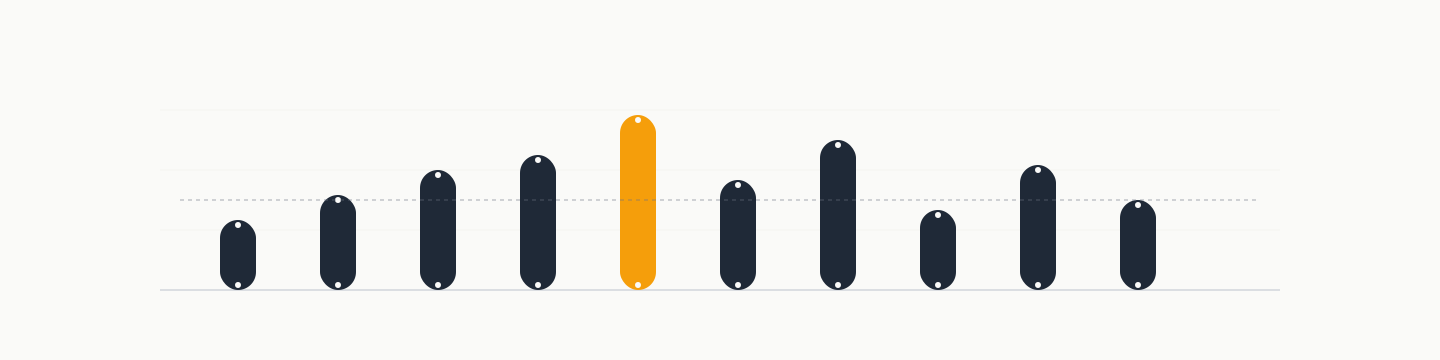
The median small business pays $147/month for commercial auto insurance at standard $1M combined single limit (CSL) is standard for most small business; $1M/$2M split limits where the carrier defaults that way limits. Most quotes fall between $31 and $1333 per month. The spread reflects the seven factors below, with industry classification and revenue typically driving the largest swings.
Benchmark from Insureon Commercial Auto cost benchmark. Quoted figures reflect bound small-business policies, not survey self-reports.
What affects your commercial auto insurance cost
Carriers don't price commercial auto insurance from a single number. These are the seven inputs they actually weigh, in roughly the order they move premium most.
Vehicle type and value
A $30K work van costs significantly less to insure than a $80K cube truck or a $150K specialty vehicle. Physical damage premium scales linearly with vehicle value; liability premium is more sensitive to vehicle type (pickup, van, box truck, semi).
Driver records and experience
Each named driver's MVR (motor vehicle record) is rated. A single at-fault accident or major violation in the past 3 years can add 20–40% to the vehicle's premium. Carriers in our coverage typically run MVRs at quote and at renewal.
Annual mileage and use radius
A van that drives 15K miles a year within 50 miles of base costs materially less to insure than the same van driving 35K miles regionally. Long-haul radius (>200 miles) typically requires a different carrier appetite.
Industry / use type
Service trucks for trades, delivery vehicles, sales fleets, and contractor pickups all rate differently. Hauling hazardous materials, livestock, or specialty cargo triggers separate coverage requirements and surcharges.
Coverage limits
$1M combined single limit (CSL) is the typical small-business default. Split limits ($300K/$500K/$100K) are common at lower entry points. Moving from $500K to $1M CSL adds 15–25% in premium and is usually worth it for any business with employee drivers. Single-claim severity has trended up over the past decade.
Deductible
Comp/collision deductibles range $250–$2,500. Moving from $500 to $1,000 typically cuts physical-damage premium 8–12%. Liability has no deductible.
Garaging address
Where the vehicle is parked overnight (not the business address. The actual overnight location) drives premium 15–35% by ZIP. Urban high-theft ZIPs surcharge; rural and suburban garaging cuts premium materially.
Stop guessing. Get an actual commercial auto insurance price.
Tell us your industry, state, and size. We'll match you to the carriers most likely to quote commercial auto insurance for your profile, with starting prices side-by-side.
Commercial Auto Insurance cost by industry
Industry classification is the single biggest premium driver. Same coverage, same limits, but a different class code can mean a 4×–10× difference in what carriers charge.
| Industry | Range visualization | Annual range |
|---|---|---|
| Personal Trainers | $300–$1,500 | |
| Real Estate Agents / Brokers | $1,000–$3,000 | |
| Cleaners / Janitorial | $800–$3,500 | |
| Landscapers | $1,500–$5,000 | |
| Electricians | $2,500–$8,000 | |
| HVAC Contractors | $3,000–$8,500 | |
| Plumbers | $3,500–$9,000 | |
| Restaurants | $3,500–$9,000 | |
| General Contractors | $3,000–$10,000 | |
| Trucking | $10,000–$25,000 |
Showing 10 of 16 industries with carrier-validated commercial auto insurance cost data. View all industries →
How to lower your commercial auto insurance cost
- Quote 3+ carriers at renewal. Premium spreads of 30–50% on the same coverage are routine. The cheapest carrier rotates yearly as each one's loss ratio shifts.
- Bundle into a BOP if you qualify. A business owner's policy combines GL + commercial property at typically 10–25% less than the same coverages bought separately.
- Check your industry classification code. Misclassification (usually a holdover from when the business looked different) is the single most common avoidable cost. A 10-minute conversation with the underwriter can be worth thousands.
- Set a reasonable deductible. Where it's offered, a $500–$2,500 deductible cuts premium 5–15% with negligible exposure for most small businesses.
- Pay annually, not monthly. Most carriers charge a 5–10% installment fee on monthly billing. If cash flow allows, annual saves the spread.
Top commercial auto insurance carriers by pricing transparency
Carriers ranked against our 6-dimension methodology, filtered to those we cover that write commercial auto insurance.
Sub-threshold = fewer than 20 NAIC complaints in 3 years (data is too sparse to score reliably). N/A (broker) = not a carrier. See full methodology →
| Carrier | Our score | Positioning | Starting price | Coverage | Claims | AM Best | NAIC index | States | Quote channel |
|---|---|---|---|---|---|---|---|---|---|
 | 8.1 | Broad-ladder primary carrier | GL $42/mo | 9.0/10 | 8.0/10 | A++ | Sub-threshold | 50 states | Direct online |
 | 7.9 | Single-carrier program for SMBs | GL $68/mo | 9.0/10 | 8.0/10 | A+ | Sub-threshold | 50 states | Direct online |
 | 7.8 | Digital-native micro-business | Cyber $4/mo | 7.0/10 | 7.5/10 | A+ | Sub-threshold | 50 states | Direct online |
 | 7.2 | Berkshire-backed contractual umbrella | GL $28/mo | 8.0/10 | 8.0/10 | A++ | 13.25 | 50 states | Direct online |
 | 7.0 | Venture-backed tech & SaaS | — | 7.0/10 | 7.0/10 | — | N/A (broker) | 50 states | Broker portal |
About complaint index data: Values are 3-year averages from NAIC Consumer Information Source for commercial liability. Carriers with fewer than 20 complaints in the 3-year window are labeled "sub-threshold". A reliability call about data volume, not a finding about the carrier. Brokers (Category D) are structurally N/A. See our complete methodology.
- 8.1
- Positioning
- Broad-ladder primary carrier
- Starting price
- GL $42/mo
- Coverage
- 9.0/10
- Claims
- 8.0/10
- AM Best
- A++
- NAIC index
- Sub-threshold
- States
- 50 states
- Quote channel
- Direct online
- 7.9
- Positioning
- Single-carrier program for SMBs
- Starting price
- GL $68/mo
- Coverage
- 9.0/10
- Claims
- 8.0/10
- AM Best
- A+
- NAIC index
- Sub-threshold
- States
- 50 states
- Quote channel
- Direct online
- 7.8
- Positioning
- Digital-native micro-business
- Starting price
- Cyber $4/mo
- Coverage
- 7.0/10
- Claims
- 7.5/10
- AM Best
- A+
- NAIC index
- Sub-threshold
- States
- 50 states
- Quote channel
- Direct online
- 7.2
- Positioning
- Berkshire-backed contractual umbrella
- Starting price
- GL $28/mo
- Coverage
- 8.0/10
- Claims
- 8.0/10
- AM Best
- A++
- NAIC index
- 13.25
- States
- 50 states
- Quote channel
- Direct online
- 7.0
- Positioning
- Venture-backed tech & SaaS
- Starting price
- —
- Coverage
- 7.0/10
- Claims
- 7.0/10
- AM Best
- —
- NAIC index
- N/A (broker)
- States
- 50 states
- Quote channel
- Broker portal
Commercial Auto Insurance cost FAQs
How much does commercial auto insurance cost?
Most small businesses pay between $31 and $1,333/month for commercial auto, with a median near $147/month per Insureon. A single van or pickup with a clean driver runs at the low end; multi-vehicle fleets with regional radius and any driver-record issues cluster higher.Is my personal auto policy enough if I use my car for work occasionally?
No. Personal auto policies explicitly exclude vehicles used for business purposes beyond ordinary commuting. Including delivery, client visits, hauling tools or materials, and any compensated transportation. A business-use claim on a personal policy is the most common commercial-auto coverage gap. If your car is regularly used for work, you need either commercial auto or a hired-and-non-owned auto endorsement on your BOP.What's the difference between commercial auto and hired-and-non-owned auto (HNOA)?
Commercial auto covers vehicles you own or lease in the business name. HNOA covers vehicles your employees drive for work that aren't owned by the business. Typically employee-owned cars used for client visits or errands. Most BOPs include HNOA as an endorsement; commercial auto is a separate policy. Many small businesses need both.Do I need commercial auto if I drive for Uber, Lyft, or DoorDash?
Yes. And standard commercial auto often won't write rideshare risk. Most rideshare drivers need a specific rideshare endorsement on a personal auto policy or a TNC-specific commercial auto product. The exposure during the "ride accepted but passenger not yet picked up" period is the gap that creates claims problems.What is "combined single limit" coverage?
CSL is a single per-accident liability limit covering bodily injury and property damage together (e.g., $1M CSL means $1M total per accident). Split limits state separate per-person, per-accident BI, and PD limits ($300K/$500K/$100K). CSL is more flexible, a single severe injury claim can use the full limit, but is roughly 5–10% more expensive than equivalent split limits.Are commercial auto premiums tax-deductible?
Yes. Commercial auto premiums are deductible as ordinary and necessary business expenses per IRS Publication 535. For mixed-use vehicles, the deduction is proportional to business use percentage.Does my BOP cover business use of my personal car?
Usually only for hired-and-non-owned auto liability. Not physical damage to your personal car. If your car is damaged while being used for business, your personal auto policy may decline the claim and HNOA does not cover physical damage to non-owned vehicles. Owners using a personal vehicle heavily for business should add their car to a commercial auto policy, not rely on personal-plus-HNOA.How do I lower commercial auto premium for a small fleet?
Three highest-leverage moves: raise collision deductibles to $1K+ on older vehicles, document a driver-screening policy with annual MVR pulls, and quote at least three carriers. Premium variance for the same fleet across carriers routinely runs 25–40%. See our comparison quiz for ranked carrier matches.
Methodology & sources
Median monthly figures and typical-range bounds come from Insureon's published carrier-quote benchmarks. These are real bound-policy quotes, not survey self-reports. It's the most representative public dataset of small-business premium ranges.
Per-policy starting-price floors are sourced from the carriers we cover (10+ small-business insurers) at their published advertised rates. We don't average competitive intel; we report what each carrier publishes.
Industry-wide context (NAIC complaint indices, III definitions, SBA guidance, IRS Publication 535 deductibility) sources every claim that isn't a price benchmark. State-specific WC rates, when shown, originate from each state's rating bureau (NCCI or independent).
Sources cited
Stop guessing. Get an actual commercial auto insurance price.
Tell us your industry, state, and size. We'll match you to the carriers most likely to quote commercial auto insurance for your profile, with starting prices side-by-side.