

Product Liability Insurance cost guide
How much does Product Liability Insurance cost for small businesses in 2026? Benchmarks, factors, carrier pricing, and how to save.
Coverage overview
Product liability covers legal defense and settlement costs when a product made, distributed, or sold by your business causes injury or property damage to a third party.
Manufacturers, importers, distributors, retailers selling private-label products, food and beverage businesses, businesses producing or selling any physical product where defect-caused injury is plausible.
Average cost
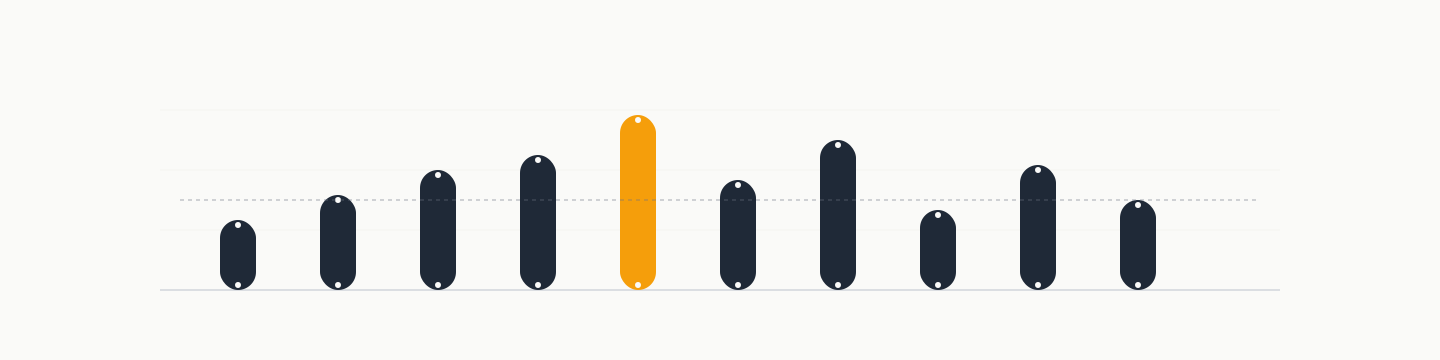
The median small business pays $50/month for product liability insurance at standard $1M per occurrence / $2M aggregate (typically included in GL or BOP) limits. Most quotes fall between $25 and $1000 per month. The spread reflects the seven factors below, with industry classification and revenue typically driving the largest swings.
Benchmark from BIC carrier-pricing dataset; Insureon/III product-liability guidance. Quoted figures reflect bound small-business policies, not survey self-reports.
What affects your product liability insurance cost
Carriers don't price product liability insurance from a single number. These are the seven inputs they actually weigh, in roughly the order they move premium most.
Product type and risk class
Low-risk products (apparel, books, decorative items) are typically included in standard GL with no surcharge. Higher-risk products (consumables, children's products, electrical equipment, items with health or safety claims) require specific underwriting. The very-high-risk categories (firearms, certain chemicals, infant products) often require standalone monoline product-liability with higher premiums.
Annual product sales / revenue
Product-liability premium scales with product sales volume. A retailer selling $500K of low-risk goods pays modestly; a manufacturer with $5M in sales of higher-risk products pays materially more. Because both claim frequency and severity scale with units in market.
Manufacturing involvement
Pure retailers (selling other manufacturers' products) face less direct liability than manufacturers because the manufacturer is the primary defendant. Resellers face vicarious-liability exposure that requires fewer specific endorsements. Manufacturers, importers, and private-label sellers face direct exposure that drives standalone product-liability needs.
Product distribution channels
Direct-to-consumer (e-commerce) sellers face different exposures than wholesale distributors. International distribution adds product-liability complexity (foreign jurisdiction claims, varying product-safety standards) and typically requires worldwide-territory endorsements at 15–30% premium increase.
Claims history and recalls
A single product-liability claim or recall in the past 5 years typically adds 30–60% to renewal. Multiple claims often push the account to surplus lines or specialty product-liability markets. Major recalls can affect bonding capacity and lender relationships beyond the insurance side.
Quality-control practices
Documented QA processes, batch tracking, supplier-vetting procedures, and product-recall plans unlock 5–15% credits with carriers that price on submission quality. The credits matter most on higher-volume or higher-risk products.
Stop guessing. Get an actual product liability insurance price.
Tell us your industry, state, and size. We'll match you to the carriers most likely to quote product liability insurance for your profile, with starting prices side-by-side.
Product Liability Insurance cost by industry
Industry classification is the single biggest premium driver. Same coverage, same limits, but a different class code can mean a 4×–10× difference in what carriers charge.
| Industry | Annual range |
|---|---|
| E-commerce / Online Retail | $1,500–$5,000 |
Showing 1 of 2 industries with carrier-validated product liability insurance cost data. View all industries →
How to lower your product liability insurance cost
- Quote 3+ carriers at renewal. Premium spreads of 30–50% on the same coverage are routine. The cheapest carrier rotates yearly as each one's loss ratio shifts.
- Bundle into a BOP if you qualify. A business owner's policy combines GL + commercial property at typically 10–25% less than the same coverages bought separately.
- Check your industry classification code. Misclassification (usually a holdover from when the business looked different) is the single most common avoidable cost. A 10-minute conversation with the underwriter can be worth thousands.
- Set a reasonable deductible. Where it's offered, a $500–$2,500 deductible cuts premium 5–15% with negligible exposure for most small businesses.
- Pay annually, not monthly. Most carriers charge a 5–10% installment fee on monthly billing. If cash flow allows, annual saves the spread.
Top product liability insurance carriers by pricing transparency
Carriers ranked against our 6-dimension methodology, filtered to those we cover that write product liability insurance.
Sub-threshold = fewer than 20 NAIC complaints in 3 years (data is too sparse to score reliably). N/A (broker) = not a carrier. See full methodology →
| Carrier | Our score | Positioning | Starting price | Coverage | Claims | AM Best | NAIC index | States | Quote channel |
|---|---|---|---|---|---|---|---|---|---|
 | 8.1 | Broad-ladder primary carrier | GL $42/mo | 9.0/10 | 8.0/10 | A++ | Sub-threshold | 50 states | Direct online |
 | 8.1 | Broker comparing 8+ carriers | GL $21/mo | 8.5/10 | 7.5/10 | — | N/A (broker) | 50 states | Broker portal |
 | 7.9 | Single-carrier program for SMBs | GL $68/mo | 9.0/10 | 8.0/10 | A+ | Sub-threshold | 50 states | Direct online |
 | 7.8 | Digital-native micro-business | Cyber $4/mo | 7.0/10 | 7.5/10 | A+ | Sub-threshold | 50 states | Direct online |
 | 7.2 | Berkshire-backed contractual umbrella | GL $28/mo | 8.0/10 | 8.0/10 | A++ | 13.25 | 50 states | Direct online |
 | 7.0 | Professional services E&O focus | GL $30/mo | 7.5/10 | 8.0/10 | A | 8.15 | 50 states | Direct online |
About complaint index data: Values are 3-year averages from NAIC Consumer Information Source for commercial liability. Carriers with fewer than 20 complaints in the 3-year window are labeled "sub-threshold". A reliability call about data volume, not a finding about the carrier. Brokers (Category D) are structurally N/A. See our complete methodology.
- 8.1
- Positioning
- Broad-ladder primary carrier
- Starting price
- GL $42/mo
- Coverage
- 9.0/10
- Claims
- 8.0/10
- AM Best
- A++
- NAIC index
- Sub-threshold
- States
- 50 states
- Quote channel
- Direct online
- 8.1
- Positioning
- Broker comparing 8+ carriers
- Starting price
- GL $21/mo
- Coverage
- 8.5/10
- Claims
- 7.5/10
- AM Best
- —
- NAIC index
- N/A (broker)
- States
- 50 states
- Quote channel
- Broker portal
- 7.9
- Positioning
- Single-carrier program for SMBs
- Starting price
- GL $68/mo
- Coverage
- 9.0/10
- Claims
- 8.0/10
- AM Best
- A+
- NAIC index
- Sub-threshold
- States
- 50 states
- Quote channel
- Direct online
- 7.8
- Positioning
- Digital-native micro-business
- Starting price
- Cyber $4/mo
- Coverage
- 7.0/10
- Claims
- 7.5/10
- AM Best
- A+
- NAIC index
- Sub-threshold
- States
- 50 states
- Quote channel
- Direct online
- 7.2
- Positioning
- Berkshire-backed contractual umbrella
- Starting price
- GL $28/mo
- Coverage
- 8.0/10
- Claims
- 8.0/10
- AM Best
- A++
- NAIC index
- 13.25
- States
- 50 states
- Quote channel
- Direct online
- 7.0
- Positioning
- Professional services E&O focus
- Starting price
- GL $30/mo
- Coverage
- 7.5/10
- Claims
- 8.0/10
- AM Best
- A
- NAIC index
- 8.15
- States
- 50 states
- Quote channel
- Direct online
Product Liability Insurance cost FAQs
How much does product liability insurance cost?
For most small businesses, product liability is included in general liability or BOP at no incremental cost. Products-and-completed-operations coverage is part of standard GL. Standalone product liability for higher-risk or higher-volume product businesses runs between $25 and $1,000/month depending on product category, sales volume, and limits.Is product liability included in my general liability policy?
Yes. For most small-business GL forms. The "products and completed operations" coverage within standard GL IS product liability for typical retail, restaurant, and small-manufacturing exposures. Standalone product liability is needed only for very-high-risk product categories or businesses where carriers exclude products from the GL form.Who needs standalone product liability insurance?
Three categories: (a) businesses whose products are excluded from standard GL (firearms, certain chemicals, infant products, supplements with health claims), (b) high-volume manufacturers whose product sales materially exceed typical GL limits, and (c) businesses required by contract to carry standalone product liability (large retailer master vendor agreements often require this).Does product liability cover product recalls?
Most standard product-liability policies do not cover recall costs (notification, retrieval, replacement). Recall coverage is a separate endorsement or standalone product-recall policy. Recall coverage matters most for food, consumer products, and businesses with regulated product categories. Typical recall costs run $25K–$1M+ depending on product reach.What's the difference between products and completed operations?
Products coverage applies to claims arising from a product after it leaves your premises. Completed operations applies to work performed and completed at a customer's premises (typical for contractors). Most GL forms bundle them together, but the rating bases differ. Products is rated on sales; completed operations on payroll.Are product liability premiums tax-deductible?
Yes. Product liability premium (whether bundled in GL or standalone) is deductible as an ordinary and necessary business expense per IRS Publication 535.Does product liability cover claims by employees?
No. Product liability covers third-party (non-employee) bodily injury and property damage. Employee injuries are covered by workers compensation; employee employment-practices claims are covered by EPLI.Does product liability extend to international sales?
Standard product liability is typically limited to occurrences in the US, US territories, and Canada. International sales require a worldwide-territory endorsement, typically 15–30% premium increase. Foreign-jurisdiction claims add procedural complexity and often require local-counsel arrangements that increase total claim cost.
Methodology & sources
Median monthly figures and typical-range bounds come from Insureon's published carrier-quote benchmarks. These are real bound-policy quotes, not survey self-reports. It's the most representative public dataset of small-business premium ranges.
Per-policy starting-price floors are sourced from the carriers we cover (10+ small-business insurers) at their published advertised rates. We don't average competitive intel; we report what each carrier publishes.
Industry-wide context (NAIC complaint indices, III definitions, SBA guidance, IRS Publication 535 deductibility) sources every claim that isn't a price benchmark. State-specific WC rates, when shown, originate from each state's rating bureau (NCCI or independent).
Sources cited
Stop guessing. Get an actual product liability insurance price.
Tell us your industry, state, and size. We'll match you to the carriers most likely to quote product liability insurance for your profile, with starting prices side-by-side.